Research interest
Molecular Approaches
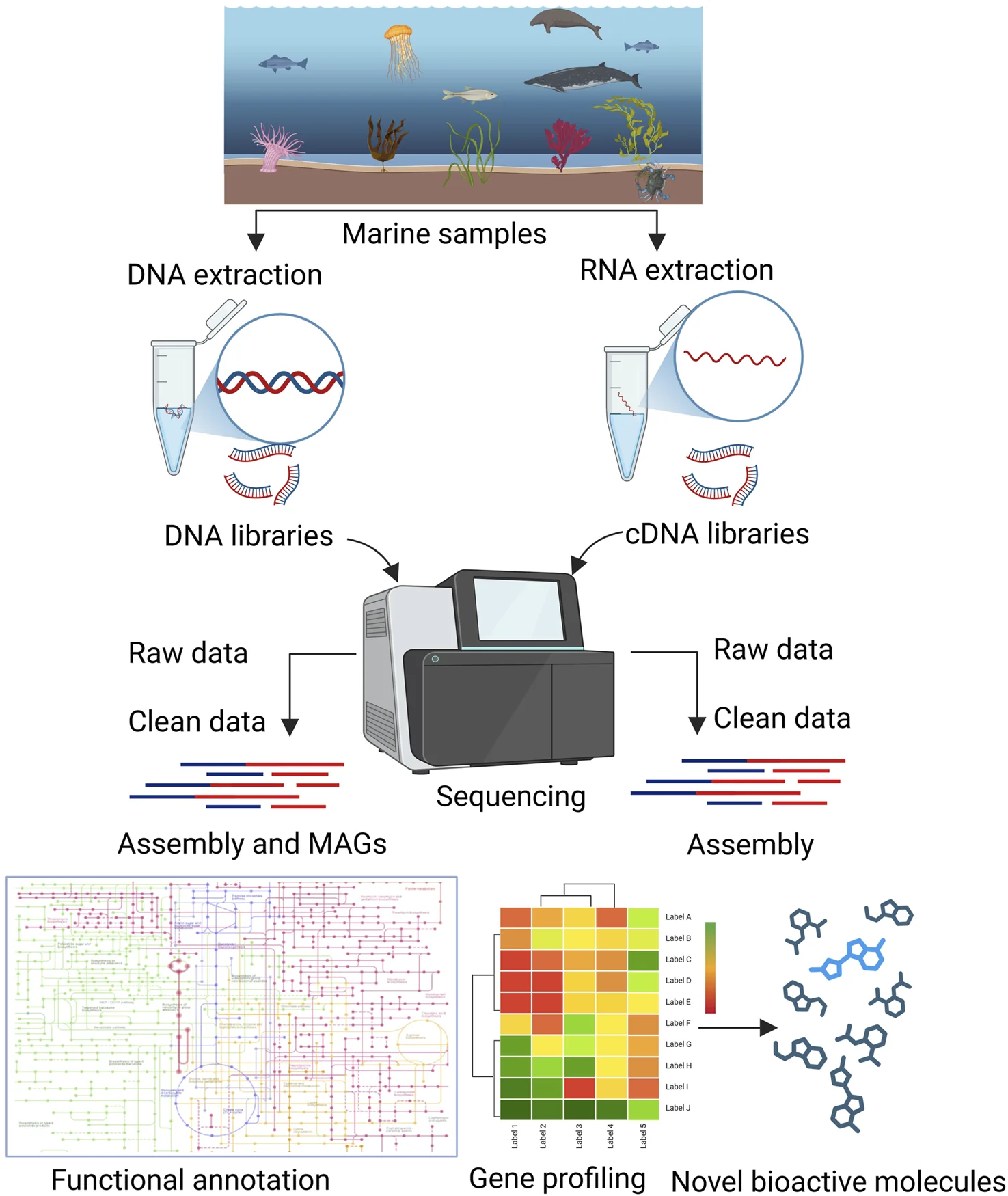
Some of the ocean’s most promising chemistry comes from microbes that no one has ever grown in a lab. For decades, that kept it out of reach. Modern techniques are changing that. By reading DNA straight from seawater and sediment, we can now find the genes behind useful molecules without needing to culture the organisms that carry them. That makes these approaches especially valuable in the deep sea, where life is hard to reach and even harder to grow.
It starts with metagenomics, which sequences all the DNA in a sample at once, including DNA from microbes that have never been cultured. Genome mining then sifts through that data to uncover biosynthetic gene clusters, the sets of genes that build natural products. Many deep-sea genes look like nothing we have seen before, so bioinformatics and newer tools like protein language models help predict what they might do. With synthetic biology, the most promising clusters can then be moved into a host organism that grows easily in the lab. Finally, metabolomics verifies which molecules actually get made.
This is a direction I am actively building toward, pairing a wet-lab background with the computational skills the field increasingly runs on.
More coming soon.